This story has been developing in the background rather quickly and today saw an official announcement. The AHL’s Board of Governors has unanimously granted conditional approval of the transfer of ownership of the Springfield Falcons AHL franchise to the Arizona Coyotes including the relocation efforts from Springfield, Massachusetts to Tucson, Arizona for the 2016-17 season.
SPRINGFIELD, Mass. … Convening today in Chicago for its Spring Meeting, the American Hockey League’s Board of Governors unanimously granted conditional approval of the transfer of ownership of the Springfield Falcons AHL franchise to the National Hockey League’s Arizona Coyotes, as well as the relocation of that franchise from Springfield, Mass., to Tucson, Ariz., beginning with the 2016-17 season.
Should all conditions of the transaction be met, the Coyotes’ AHL franchise will begin play this fall at the Tucson Convention Center Arena.
The Board of Governors is also currently reviewing an application for the transfer of ownership and relocation of the Portland Pirates AHL franchise from Portland, Maine, to Springfield, Mass., for 2016-17. It is expected the Board will reconvene to vote on that request within two weeks.
Founded in 1936 and now with franchises in 30 cities across North America, the American Hockey League serves as the top development league for the players, coaches, managers, executives and broadcasters of all 30 National Hockey League teams. More than 88 percent of today’s NHL players are American Hockey League graduates, and for the 15th year in a row, more than 6 million fans have attended AHL games in 2015-16.
This likely sets the stage for another one of those lovely AHL realignment efforts with a new team joining the Western Conference’s Pacific Division. If I had to hazard a guess, considering the Springfield Falcons were an Eastern Conference team, it wouldn’t be a bad idea to finally kick the Charlotte Checkers out of the Western Conference and make the two AHL teams swap conferences.
As always, the AHL is an ever changing landscape so this probably isn’t going to be the last bit of news regarding teams moving around. This especially is becoming more and more true with many NHL teams wanting their AHL affiliates closer to home. Considering the Milwaukee Admirals and Nashville Predators have been paired at the hip since the Predators franchise came into existence it makes you wonder if that shift in business practices would ever see a change closer to Nashville. Could the Predators swap out the Admirals as the AHL affiliate for say the current ECHL affiliate the Cincinnati Cyclones down the road? The term “The Road To Nashville Goes Through Milwaukee” is spoken quite a lot from everyone topside in Nashville. I have to believe the long standing bond between the two is pretty safe… for now.
Something that I was excited about coming into the 2015-16 season was that the Milwaukee Admirals were getting bigger boomers into the mix. Yes, the likes of a Mike Liambas, Rich Clune, or Triston Grant are fun and all but, as a group, more size was needed. Enter this season where the Admirals outfitted guys like Cody Bass, Jamie Devane, and Adam Payerl to grind the opposition up along the boards… and occasionally through the glass.
I’ve had the chance to see some pretty flashy goals watching the Admirals. There have been a few great fights, too. But I don’t remember a time where I froze up on press row more than when I realized that Bass checked Zach Palmquist through the glass. It wasn’t that the glass shattered. Bass effectively hydraulic pressed Palmquist into the glass and punched him through it. That panel exploded and left a Palmquist sized hole in it. These were the remains of that panel. RIP Panel.
Tomorrow in “Best Of” will feature the Best Save of the Admirals 2015-16 Season. What is your pick for the best save of the Admirals season and who made it: Juuse Saros or Marek Mazanec?
The Milwaukee Admirals season is over which means the start of end-season material here at Admirals Roundtable. This week will be “Best Of” Week which will cover: Best Fight, Best Hit, Best Save, Best Goal, and Best Game. As always, I encourage everyone time chime in and get their say or recommendations in via the comment section. Considering the fight pool this season was pretty cut and dry. I’ll take this first one head on.
There wasn’t a more jaw dropping fight this season than the moment Jamie Devane knocked out Daniel Maggio. It may not have been the fight itself that made it the top scrap of the season as much as the uppercut finish. There haven’t been many legit KO’s that I can remember in recent Admirals history. Devane provided one that will be hard to forget.
Before going anywhere else, because it is worth talking about, Maggio was clearly hurt from this fight. He was knocked out cold, staggered back, and needed assistance to get off the ice. He would miss the next five-games for the San Antonio Rampage but did carry on with the rest of the season. Actually, he wound up taking eight more fighting majors by the end of the season. So, all is well in Maggio-land.
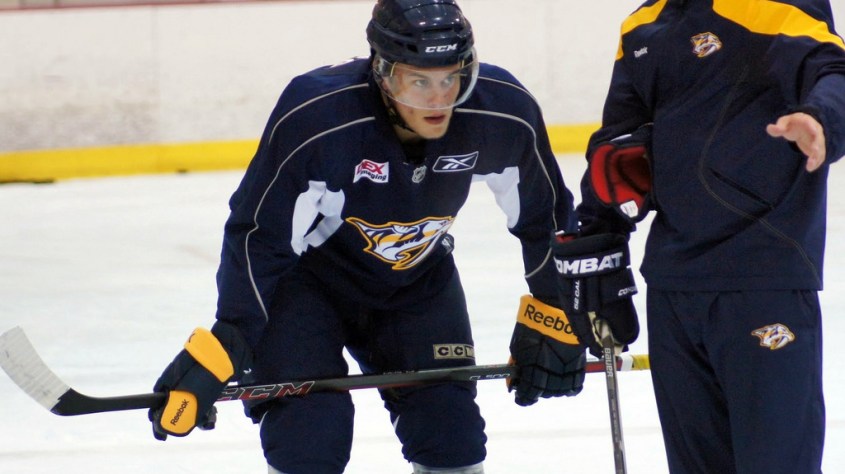
One of the real bright spots for last night’s Nashville Predators viewing party at Major Goolsby’s was the pleasantly surprising developments that took place in pre-game warm ups. Pontus Åberg was on the ice. Mike Ribeiro wasn’t. That wasn’t anything too special right away considering Åberg looked set to make his NHL debut in Game 1 against the San Jose Sharks only to be healthy scratched right at game-time. This time it was different. Ribeiro stayed a scratch. And the Predators second round draft pick from the 2012 NHL Draft, 22-year old Swede Åberg, was announced to the lineup for his NHL Debut.
As much of a shock as it might feel for some in Nashville, probably more so for the casual fans tuning in for the 2016 Stanley Cup Playoffs, it shouldn’t be. To make your pro debut in a playoff scenario where the team has their back up against the wall in a 2-0 series hole speaks volumes that far exceed the player himself. The foundation of the Predators is build upon by successful scouting, drafting, and developing. When you pause to look around the people Åberg suited up with it all makes sense. The profile of the game is bigger. The moment of making your NHL debut is huge. But, at the end of the day, Åberg found himself in a lineup with four players that he suited up with in Milwaukee last season or even this season. It just becomes the same old game at that point.
(Photo Credit: Scott Paulus)
The confidence of the Predators coaching staff to make a lineup change of a veteran in Ribeiro for an NHL debutant in Åberg says an awful lot about their trust in the developmental process. Åberg has playoff experience but, when you look back on his professional or senior level playing career, the bulk of that has come in his native Sweden. Including last night’s 4-1 Predators win in which he debuted Åberg has played in a total of 30 playoff games since the 2011-12 season: 13 games with Djurgårdens IF (SHL and Allsvenskan), 13 games with Färjestad BK, 3 games with the Milwaukee Admirals (AHL), and 1 game with the Nashville Predators (NHL). Prior to last night’s game his only North American playoff playing experience came in the recent weeks leading up to his debut when he and his Admirals teammates were swept in the first round of the 2016 Calder Cup Playoffs by the Grand Rapids Griffins. So, if you were thinking the decision of Åberg over Ribeiro was a matter of big game experience – you would be wrong. It was less to do about that and far more to do about the player that Åberg has become in the space of his first two full-seasons of North American hockey playing in the AHL with the Admirals.
You would be hard pressed to make a bigger introduction to a new team, new fan base, or -simply- new country better than the way that Åberg did last season. In the first period of his North American playing career he scored a spectacular solo goal. He slashed through several members of the Charlotte Checkers before dusting off a goalie who almost single-handedly eliminated the Admirals in the first round of the playoffs the year prior – Drew MacIntyre. You could watch that goal over and over again and still make the same face that Brendan Leipsic is making as he goes to celebrate with Åberg in the corner. It was brilliant.
(Photo Credit: Scott Paulus)
It would have been fantastic if the debut season in North America could have shined that bright every night for Åberg and the Admirals in the 2014-15 season. It would have – but life at the developmental ranks isn’t without its immense learning curves and struggles. Åberg was off to a great start in his first season as a member of the Admirals. He scored 19 points (13 goals, 6 assists) in his first 27 games. He then proceeded to slow way down at the turn of the calendar to only muster up 15 points (3 goals, 12 assists) from his last 42 games of the season. The Admirals weren’t all that sharp around him either, mind you, as the team missed out on the Calder Cup Playoffs that season for the first time since the Admirals inaugural season in the AHL – a streak that spanned twelve consecutive playoff appearances – gone. The Admirals finished in last place of the Midwest Division with a record of 33-28-8-7 (81 points, 0.533 points percentage).
If there was any saving grace to the Admirals final few games of the 2014-15 season it was when head coach Dean Evason really started to challenge players to compete more at the finish line. Åberg rose to the challenge as he notched 4 assists in the Admirals last 4 games of the season including ripped 17 shots on goal in the final month. The precision of his shot wasn’t quite there, 1 goal from his final 31 games, but the fire from earlier in the season was reignited. That attitude carried into the off-season and followed into the 2015-16 season.
There could have been some early concerns, both on Åberg’s part as well as those watching him, that he again wasn’t quite finding the back of the net to start this season. October came and went without a goal to stretch his goalless drought in the AHL to 14 games. The first game of November comes and, with a primary assist from fellow Swede Max Görtz, that goal finally came. Now would be the fun opportunity to cheat time a bit and jump to the end of the regular season to cite that Åberg ended up being the Admirals top goal scorer with 25 goals from 74 games.
(Photo Credit: Scott Paulus)
The goal scoring feat for Åberg was great but that alone isn’t something that sees a player elevated to debut in the middle of the Stanley Cup Playoffs. The precision element to his game this season was a very real element to his improvement. In 2014-15, he scored 16 goals from 158 shots on goal. In 2015-16, he scored 25 goals from 159 shots on goal. The precision spills across from shooting to other avenues of his game. His passing was smarter. His overall defense and work on the back-check was more attentive and provided a more detailed touch to his already talented offensive skill set. By the end of the season he was being double-shifted by Evason, à la Taylor Beck, and was eating up the minutes while providing the Admirals an absolute maximum on offense. In the Admirals last 21 games of the regular season Åberg scored 22 points (11 goals, 11 assists) while being held without a point in only 5 games. He was becoming Mr. Everything and was the hottest Admirals forward entering the playoffs.
I already explained at length why the Admirals playoffs were what they were. It’s unfortunate that the Admirals 2015-16 season ended as quickly as it did. The team went from the bottom of the division to winning a division title for the first time in five-seasons and were the second best team in the Western Conference entering the playoffs. If you wanted to find a specific player that summed up the Admirals headache inducing match-up against the Griffins it would be Åberg. He had 4 points (2 goals, 2 assists) in 10 games against the Griffins this season which includes them shutting him out offensively in the three-game playoff series. That doesn’t make Åberg bad. That doesn’t mean Åberg cooled off. That’s just another feather in the cap of a Griffins team that is supremely polished.
As Åberg arrived to join the Predators for the second round playoff series against the Sharks it was his first career NHL recall. There are now several “Black Aces” up with the Predators and for nearly all of them this time isn’t exactly about getting on the ice anywhere near as much as it is simply taking in the environment and experience. At the AHL level, you see so many college and junior playing kids turn up at season’s end to get that taste of what life at the pro level is about. That’s really what being a Black Ace is more than anything. It’s a look past that glass ceiling that so many players are knocking on repeatedly to see if anyone is still paying attention. Nashville pays attention and their developmental process screams it. All you need to do is look over their roster and count down all the players that are there that played in Milwaukee. Åberg did more than take in the environment last night. He participated in it. That shouldn’t be surprising. Look at that Predators team and look at those Admirals teams of the past. It truly is a play together, learn together, win together mentality. Åberg is just the latest example of that.
There have already been two members of the Milwaukee Admirals who joined the Nashville Predators during their second round playoff series against the San Jose Sharks. Both Pontus Åberg and Marek Mazanec were summoned ahead of that series and were with the Predators in San Jose in the first two games against the Sharks.
Fiala was the Admirals leading scorer this past season. He scored 50 points (18 goals, 32 assists) in 66 games. He played 5 games for the Predators this season and scored his first career NHL goal on 1/14/16 on the road against the Winnipeg Jets.
This past season was Kamenev’s first full campaign in North America. He spent the entirety of the 2015-16 season playing center and produced 37 15 22 in 57 games which puts him at the third highest points per game ratio of Admirals who played more than 50 games this season. He missed time due to his participation in the 2016 IIHF World Junior Championships where he was the captain of Team Russia and earned silver while producing 6 points (5 goals, 1 assist) in 7 games.
Gaudreau was the true feel good story of this past season for the Admirals. He signed as an undrafted free agent with the Admirals back in 2014-15 where he split time between the AHL and ECHL totaling a combined 18 points (9 goals, 9 assists) from 57 games between the Admirals and the Cincinnati Cyclones. This season Gaudreau performed so well that the Predators couldn’t ignore his abilities and signed him to a two-year entry level contract. Gaudreau scored 42 points (15 goals, 27 assists) in 75 games and represented the Admirals in the inaugural AHL All-Star Challenge where he won the championship game with the Central Division All-Stars.
Elliott and Potter were part of the Admirals major defensive shake-up at the middle stages of the season which also included Patrick Mullen being brought on-board. The three brought experience as well as right-handed shots from the back end for the Admirals that really boosted the team down the stretch as the team went 25-10-1-2 from their debut on 1/15/16 to the end of the regular season.
While going over the “Thank You” column that I wrote the night of the Milwaukee Admirals playoff exit you probably thought I forgot some people: the photographers. Well, that’s just simply not true because this post is entirely a massive thank you to the photographers who have once again captured so many incredible moments this season.
The main man that heads up photography for the Admirals is Scott Paulus. When he’s not with the Admirals he is more than likely helping out the Milwaukee Brewers as pitchers and catchers report for Spring Training. This opens up the window for people such as Stephanie Moebius, Jeff Hanisch, and Sara Stathas to showcase their great eye around the rink.
Someone else that deserves an Admirable mention is Jamie Wahl whose photography often ends up being used by your’s truly to craft the various memes or reaction faces that you see used on Admirals Roundtable’s social media. Her work was even brought up by Jimmy Oligny during his Fifteen interview in regards to this photo of Taylor Aronson.
It’s a shame that the Admiral of the Month Award won’t extend past the month of April. The Milwaukee Admirals 2015-16 season really did deserve a longer run. That said, the final monthly award from Admirals Roundtable was a rather easy choice to make. It had to go to Pontus Åberg.
At the end of the regular season there wasn’t a hotter player on the Admirals roster than Åberg. The numbers from the last month of the regular season pop: 9 points (6 goals, 3 assists) in 8 games, 4 power-play goals, 2 game-winning goals, 2 first-goals, an average of 2.0 shots on goal per game, and he was held without a point in just 2 games.
Similar to the Admirals as a team it’s a shame that such a great run at the end of the regular season didn’t see better results in the playoffs for Åberg. In the Admirals playoff exit the 22-year old Swede was unable to score a point. Considering the Admirals were held to a single goal in all 3 games against the Grand Rapids Griffins there wasn’t much scoring to get excited about in general. Still, something that Åberg offered that extended into the playoffs was his reliability to the team to double-shift on the wing. His all-around play was so consistent that the coaching staff really pushed him to offer up a boost when the Admirals needed it. There is a reason, despite the lack of scoring in the playoffs, why the Nashville Predators saw fit to give Åberg his first career NHL call up prior to the start of their second round playoff series against the San Jose Sharks. He was the hottest forward on the ice for the Admirals and that motor can translate to the Predators if they needed him out on the wing. With the Predators now down 2-0 to the Sharks perhaps some new blood and energy in the form of Åberg would be a good thing.
Admirable Mentions: Vladislav Kamenev, 9 points (3 goals, 6 assists) in 11 games… Juuse Saros, 5 wins from 6 starts with a 2.34 goals against average and 0.919 save percentage… Félix Girard, for his efforts in the face-off circle and work on Admirals special teams… Kevin Fiala, 7 points (2 goals, 5 assists) in 11 games… Max Reinhart, 6 points (3 goals, 3 assists) in 11 games… Max Görtz, 6 points (2 goals, 4 assists) in 11 games… Adam Payerl, 5 points (4 goals, 1 assist) in 11 games… Matt White, 5 points (2 goals, 3 assists) in 11 games…
Who do you feel was the Milwaukee Admirals top performer during the month of April? Was it Pontus Åberg, Vladislav Kamenev, or someone else? Answer in the comment section below.
The entire Western Conference has its second round of the playoffs set. The Lake Erie Monsters will be hosting the Grand Rapids Griffins. And the Ontario Reign will be hosting the San Diego Gulls in a best of seven game series format that will laughably go 1-1-1-1-1-1-1. The second round officially gets underway this coming Wednesday when the Toronto Marlies host the Albany Devils.
Enough time has officially passed where it’s safe to really plunge back into how the Milwaukee Admirals 2016 Calder Cup Playoffs ended as quickly as it did. With the Admirals having such an incredible regular season, that saw them claim their first divisional title since 2010-11, expectations for a long playoff run were high. It instead came and went as quickly as it possibly could making the playoff experience something of a blur to the landscape of everything the regular season provided. What went wrong? It isn’t a one-sentence answer.
~Handshake Line~
For as much internal complaining as there could be done there isn’t enough credit in the world that could be given to the Griffins. The opening round playoff series was a microcosm of how the head-to-head series between the two teams went in the regular season. Combine what happened in the playoffs and the Griffins went 8-3-0-0 with the Admirals never once having won consecutive games against the Griffins and only once having won two out of three games. There couldn’t have been a worse opening round opponent for the Admirals than the Griffins.
Another item worthy of bringing up is experience. I made mention prior to the start of the series that there were going to be nineteen returning names from the Griffins 2015 Calder Cup Playoffs roster. That meant having a little under 60% of a team that nearly punched a ticket to the 2015 Calder Cup Finals squaring up with an Admirals team that would give the pro debuts to Anthony Richard and Yakov Trenin in the series. As much as the Admirals looked to be playing playoff hockey in the closing stages of the regular season the actual playoff experience that the Griffins had wasn’t anything to be taken lightly. The Admirals looked to get through the playoffs on talent alone. The Griffins looked to get through the playoffs as a team that previously went to the Western Conference Finals a year ago. That’s a very real thing that made a difference in the series.
~Missing Names~
Another area that was a slight issue for the Admirals that wasn’t really the case on the opposite side of the rink was the missing names of higher ranking players. It’s hard to say anything against when the Nashville Predators have a need for their cause in the 2016 Stanley Cup Playoffs. It is, and that’s the slight unfortunate grey area of being the AHL affiliate that is also competing in a playoff run. But the lack of even someone such as a Cody Bass was a very real thing.
The Admirals captains at the start of the season went as follows: Colton Sissons (C), Cody Bass (A), and Conor Allen (A). Sissons would go up to the Predators. Bass would go up to the Predators. Allen would get traded mid-season to acquire Patrick Mullen. Your initial leadership group wasn’t available for the playoffs. This pushed the captains to be: Max Reinhart (A), Félix Girard (A), and Jamie Devane (A). The coaching staff has made mention that the leadership group of the room has been great, so you can’t really have any gripes with that, but there is something to be said of losing out on the on and off-ice abilities that a Bass or Sissons provides.
I’m very happy to see Bass taking part of the Predators playoff run. I’ve long been a proponent of calling up the veteran AHL talent to fill a lower line role than having one of your high energy scoring prospects be subjected to a lesser role where they are tasked with playing outside of their comfort zone and be mistake free and defensive. That’s why having a Bass up with the Predators, and not a Kevin Fiala, is a good thing. What I do question though is what’s going on in the head of Austin Watson when you’re technically that bridge gap and being superseded by Bass. You would think the two could be contributing to the NHL and AHL causes all the same during the playoffs but, instead, Watson -someone who wasn’t playoff eligible to the Admirals- is being kept low on the totem pole. He’ll be seeing his contract kick up to a one-way deal next season but is being treated less of a Black Ace than Pontus Åberg who, for a brief half-hour period, looked as though he would be making his NHL debut in Game 1 of the Predators playoff series against the San Jose Sharks. I’m not sure how that inspires confidence nor helps the entire organization be at their optimum.
Then there is “Mr. Elephant in the Room” Taylor Aronson who, according to Milwaukee Admirals head coach Dean Evason, left the team due to personal reasons with three-games remaining in the regular season. He never ended up returning for the playoff run so the Admirals were without their best defenseman this season against the Griffins. That was a massive loss considering how many situations Aronson contributes for the Admirals. In the Admirals last six-games of the season without him they went 1-5-0-0 with five straight losses to end the season. Aronson is always the first man over the boards for the Admirals power-play. In those six-games without him they were 5/31 (16.1%) on the power-play including 2/17 (11.8%) during the playoff series against the Griffins. The Admirals ended the regular season with the second best power-play in the entire AHL (21.2%). Losing Aronson, who provided 18 assists on the power-play from 64 games in the regular season games, was huge.
~Zebras and Rule Books~
It is 100% inescapable that this topic would come. In fact, this may have been the hardest pill for all fans to swallow as the Admirals were given the unceremonious exit from the 2016 Calder Cup Playoffs. The chaos and drama of the Admirals and Griffins opening round series didn’t come entirely from the on-ice product that the two teams dished up as much as the embarrassing flaws and ineptitude of AHL officiating and rules were exposed in broad daylight.
79.1 Video Review – It shall be the Referee’s sole discretion as to whether the use of the video review system shall be utilized for any apparent goal or non-goal that takes place during the course of the game.
Any potential goal requiring video review must be reviewed prior to or during the next stoppage of play. No goal may be awarded (or disallowed) as a result of video review once the puck has been dropped and play has resumed.
When a team scores an apparent goal that is not immediately awarded by the on-officials and play continues, the play shall be reviewed at the next stoppage of play only at the sole discretion of the on-ice officials. If the goal is confirmed by video review, the clock
(including penalty time clocks, if applicable) shall be re-set to the time the goal was scored. If the goal is not confirmed by video review, no adjustment is required to the game clock time.
Only one goal can be awarded at any stoppage of play. If the apparent goal was scored by Team A, and is subsequently confirmed as a goal through use of video replay, any goal scored by Team B during the period of time between the apparent goal by Team A and the stoppage of play (Team B’s goal), the Team B goal would not be awarded. However, if the apparent goal by Team A is deemed to have entered the goal, albeit illegally, the goal shall be disallowed and since the play should have been stopped for this disallowed goal, no goal can be awarded to Team B on the same play. The clock (including penalty time clocks, if applicable), must be re-set to the time of the disallowed Team A goal and play resumed.
Any penalties signaled during the period of time between the apparent goal and the next stoppage of play shall be assessed in the normal manner, except when a minor penalty is to be assessed to the team scored upon, and is therefore nullified by the scoring of the goal. Refer to Rules 16.2 and 18.2. If an infraction happens after the first stoppage of play following an apparent goal (infraction after the whistle) by either team, it is assessed and served in the normal manner regardless as to the decision rendered by the video review.
79.2 Procedure – If the Referee determines the use of the video review system is necessary, the referee shall inform the off-ice official at ice level and the Public Address Announcer shall announce that “The play is now under review”. Once the play has been reviewed and deemed a goal, the goal will be announced in the normal manner. If the review reveals that the goal must be disallowed, the Public Address Announcer shall announce the reason for the disallowed goal as reported by the Referee.
When the Referee indicates there is to be a video review, all players (with the exception of the goalkeepers) will go to their respective players’ bench immediately. During the period of video review, no replay of the situation may be shown on the arena video
screen or any other public video monitor.
79.3 Situations Subject to Video Review – The following are the only situations subject to video review by the Referee:
(i) Puck crossing the goal line.
(ii) Puck crossing the goal line prior to the goal frame being dislodged.
(iii) Puck crossing the goal line prior to, or after expiration of time, at the end of the period.
(iv) Puck directed or batted into the net by a hand or foot or deliberately batted with any part of the attacking player’s body. With the use of a foot/skate, was a distinct kicking motion evident? If so, the apparent goal must be disallowed. A distinct kicking motion is one which the player propels the puck with his skate into the net. If the Referee determines that it was put into the net by an attacking player using a distinct kicking motion, it must be ruled no goal. This would also be true even if the puck, after being kicked, deflects off any other player of either team and then into the net. This is still no goal. However, a puck that enters the goal after deflecting off an attacking player’s skate or that deflects off his skate while he is in the process of stopping, shall be ruled a good goal. See also 49.2.
(v) To determine whether the puck entered the net by going through the net meshing.
(vi) To determine whether the puck entered the net from underneath the net frame.
(vii) Any situation in which the puck may have entered the net undetected by the Referee.
79.4 Coach’s Challenge – A team may request a formal Coach’s Challenge if they have their time-out available. The Coach’s Challenge must be effectively initiated prior to the resumption of play.
Only the situations subject to video review as outlined under
Rule 79.3 may be challenged.
If the Coach’s Challenge does not result in the original call on the ice being overturned, the team exercising such challenge will forfeit its time-out.
If the Coach’s Challenge does result in the call on the ice being overturned, the team successfully exercising such challenge will retain its time-out, which may be used for another challenge.
79.5 Video Review Assistant – The position of Video Review Assistant shall be recognized as an official off-ice officials position required for each League game to assist the Referee in the timely review of any situation subject to video review as outlined under Rule 79.3.
79.6 Logistics and Equipment – The video review monitor and controls shall be located at the scorer’s table positioned between the penalty boxes. The Referee shall have full control of the video review system at all times with the assistance of the Video Review Assistant.
79.7 Final Decision – If the Referee determines the use of video review is necessary, or it is utilized as a result of a Coach’s Challenge, the Referee shall not be required to consult with the Goal Judge. In determining whether to award an apparent goal, the video review must conclusively show the entire puck entered the net legally with regard to the situations subject to review as outlined above. After the play has been reviewed with the use of the video review system, the Referee shall make the final decision.
79.8 Reports – Following any game in which the video review system was utilized, the Referee must report to the League all video reviews conducted during the game.
You get all that? Great, because now we can rant a bit. There is a human element to the game of hockey. That shouldn’t mean that standard is limited to just the players. Officials get one real solid look to make a determination of a call on the ice in a game that happens at incredible speed and ferocity. Mistakes happen. They’re always going to happen. But when those mistakes happen in such a way they can drastically impact the game itself there is a problem that far exceeds an issue of on-ice officiating. The league itself must be held accountable.
Looking at how the series played out you’ll have no doubt been angry when seeing Rule 79.3 (v). It happened in quick succession during Game 3 in Grand Rapids and on both occasions saw the Griffins be awarded goals. Now comes the hard part to say that some might still be hot over: they were goals. Yes, they were goals. There is nothing wrong with saying that those were goals and video replay afforded the officials a chance to make what should have been right on the ice – right. That’s a good thing to have the game held accountable. It’s great that the officials have a chance to use the technology around them to see major points of a game be correctly handled if it wasn’t done appropriately in the moment when it happened.
Now comes the inexcusable parts…
For the AHL to not allow for video review of goaltender interference. For the AHL to have nothing in the rule book in connection to the maintenance of their goals and nets by teams or officials being obstructed to inspect goals and nets before a game, before a period, or after a game is inexcusable.
In Game 2, the Admirals were trailing 2-0 to the Griffins in the second period when Max Gortz deflected a shot by Corey Potter. The crowd finally had something to get loud about and the game was 2-1 with all kinds of momentum set to finally go the way of the Admirals. It was then waved off. Why? Goaltender Interference. It’s an unreviewable play by AHL standards yet the disallowed goal could have been quickly amended with something as simple as the jumbotron feed showing that not only was Tom McCollum not interfered with but that there wasn’t anyone within two feet of him.
What’s the point of video review if you can’t review something? What’s the point of the coach’s challenge if they can’t challenge a play on the ice? It’s as if the AHL has what they have in place to come across as professional as possible. Like looking at someone in the distance who looks to be wearing a tuxedo and a coat. Yet, the closer you get – the more you get into the details – all you’re looking at is a clown in a tuxedo t-shirt. You cannot have rules in place while ignoring other major points of conflict that can arise in the game of hockey. The AHL did. The officials made a mistake and then proceeded to stick to the letter of the rule book. And the victim of the situation, the Admirals, get nothing more than potentially being the sacrificial lamb to significant rule changes that should have been in place already. It’s inept. It’s embarrassing. And the worst thing of it all was that it was all avoidable.
~Closure~
I went into the BMO Harris Bradley Center the day after the Admirals playoff exit. It was the team’s last day together and I had the chance to speak with a great deal of the players. Time and time again I found myself saying that it wasn’t the end to the season that everyone wanted and hoped for but it doesn’t detract from how special of a season it was for the Admirals. It’s right, too. This season the Admirals were absolutely terrific. There were so many bright spots, great performances, unexpected stars, signs of great promise for the future of the Predators, and all of that is something that shouldn’t be lost on you – the fans. Even better, there is no reason why what you saw this season shouldn’t be just as good or better next season. The Admirals were an incredibly young team in 2015-16. That remains true for 2016-17. What should be exciting is the returning name talent that there will be coming back to the Admirals that took in the 2015-16 season. The close of the Bradley Center was special. The return to the Admirals original home next season will be too.
Yesterday’s news was that the Nashville Predators recalled Pontus Åberg from the Milwaukee Admirals. It wasn’t publicized by the Predators but also included in the mix was Marek Mazanec who was part of the healthy scratch brigade in last night’s 5-2 Game 1 loss against the San Jose Sharks.
Those releases aren’t to say that it is the last you will see of those guys. Especially those last three who were drafted by the Predators in recent years. It’s likely that you will see either entry level contracts signed through the Predators or standard player contracts penned to the Admirals in the off-season.
As for the “Black Aces” that typically go up to the Predators once the Admirals season ends there should be more than just Åberg and Mazanec heading up during the parent club’s playoff run. Other names that are very likely to be going to Nashville ahead of Game 3 are: Kevin Fiala, Vladislav Kamenev, Juuse Saros, Frédérick Gaudreau, Stefan Elliott, Corey Potter, and Félix Girard.
Now that the Milwaukee Admirals season has come to an end there should be a few names heading to the Nashville Predators as their playoff season continues tonight with a second round match-up against the San Jose Sharks. The first name that will be getting recalled will be Pontus Åberg whose first career NHL call-up comes during the midst of the Stanley Cup Playoffs.
Nashville, Tenn. (April 29, 2016) – Nashville Predators President of Hockey Operations/General Manager David Poile announced Friday that the club has recalled forward Pontus Aberg (PAWN-tuhs AW-buhrg) from Milwaukee (AHL).
Aberg, 22 (9/23/93), scored 25 goals and amassed 40 points in 74 games for the Admirals in 2015-16, tying for 13th among all AHLers in goals, while tying for the AHL lead in game-winning goals (8) and first goals (8). The 5-foot-11, 196-pound winger also ranked fourth on the Admirals in points; he amassed 34 points (16g-18a), ranking fifth on the team in the category, as a rookie in 2014-15. A native of Stockholm, Sweden, Aberg was Nashville’s first choice, 37th overall (second round), in the 2012 Entry Draft. He helped Farjestad advance to the 2014 Swedish Hockey League Final, earning a silver medal, and was a finalist for the 2012 Swedish Elite League Rookie of the Year with Djurgarden.
Individual tickets for Round Two of the 2016 NHL Stanley Cup Playoffs against the San Jose Sharks are on sale now and available for purchase at NashvillePredators.com. The first two contests of the series will be held in San Jose before the club returns to Bridgestone Arena for Game Three on Tuesday, May 3 (8 p.m. CT on USA) and Game Four on Thursday, May 5 (8 p.m. CT on CNBC). If necessary, Game Six will be played in Nashville on Monday, May 9 (time and broadcast info TBD). For the latest information about the 2016 Stanley Cup Playoffs, visit NashvillePredators.com, or follow @PredsNHL on Twitter using #StandWithUs.
This past-season was Åberg’s second professional playing season in North America and it was a huge leap forward. Åberg finished the 2015-16 season with 40 points (25 goals, 15 assists) from 74 games. More specifically, Åberg finished the regular season on a white hot run of 22 points (11 goals, 11 assists) in the Admirals last 21 games of the season. In that span Åberg was held without a point in just 5 games. He finished the season as the Admirals top goal scorer. More names from the Admirals are expected to join the Predators in the near future.




 Admirals Roundtable