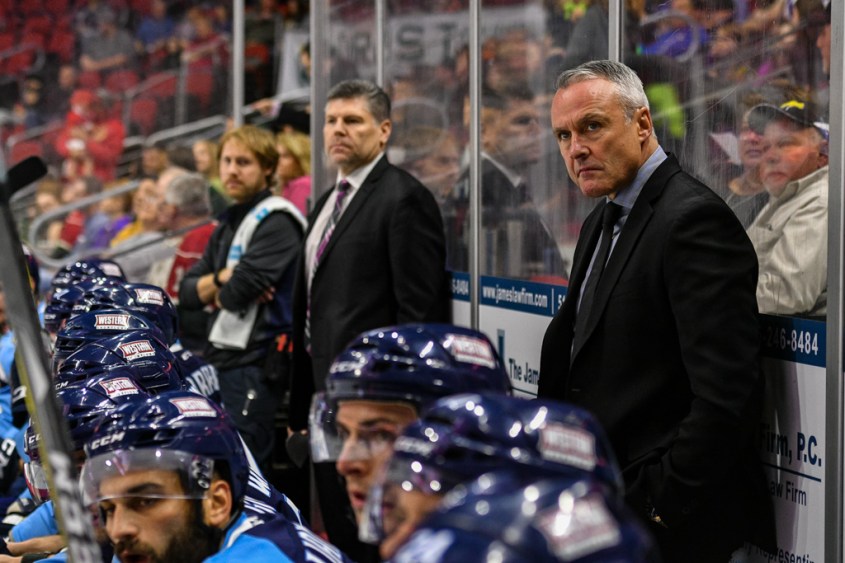
We’re only ten games into the 2016-17 season and I already feel as if a word that is going to get used a lot this season is character. The Admirals as a team has character. The UW-Milwaukee Panther Arena is an old school building that has character. This was something felt and said quickly by Milwaukee Admirals head coach Dean Evason at Media Day ahead of the season and it is already an attribute of the team that is strongly being showcased.
“We feel real good about our group of veteran people and prospects. But most importantly we’re excited about the character of this team as opposed to other teams of the past. We’ve had real good teams here. The character of this group seems really high and really good.” ~Dean Evason
What does this character element mean, you ask. To me it means having leadership far and wide in various aspects where it is needed. There are veteran players who have been part of the Admirals current group for a few seasons that know life and the process of the team and city. There are new veterans that were brought in that conduct themselves professionally on and off the ice and lend themselves to teaching and assisting those in the locker room. And the young up and coming talents of the team feature a background in their own right as leaders from previous teams, locker rooms, and have taken that mindset into the professional ranks.
Recent years the Admirals roster has been either the youngest in the American Hockey League (AHL) or among the youngest. As a developmental league you expect that to a degree but would also expect such youth to trickle into less than favorable results as opposed to the rest of the league’s more polished or experienced players and minds. Last season in particular the Admirals played 23 players who were 23-years of age or younger at some point in the season. They played 6 players that were teenagers. And that team was able to finish on top of the Central Division, nearly even the entire Western Conference, with a record of 48-23-3-2 (101 points, 0.664 points percentage).
How is something such as that achieved? Is it a simply matter of having the right pieces? Having a locker room and on-ice chemistry that clicks incredibly well? Or are there key players that pull extra weight and can be accountable when things shouldn’t be going right? The answer is of course – all of the above. What helps it all come together though is having the right leaders in the room to make it all work. The Admirals have a room filled with leaders. And this season’s team just so happens to have a room with heart and soul type players and people.
(Photo Credit: Todd Reicher)
If you were to purely judge someone such as Mike Liambas based on his career’s statistical measurements you would probably consider him to be an undersized enforcer. On paper, saying that, you can probably assess that he clearly has warrior spirit and one that can endear him to his team, teammates, and the fans. The thing is that Liambas has always been far beyond the sort of player that simply drops the gloves when he chooses to. He isn’t just a fourth line AHL level grind it out player. Liambas is a leader. Liambas is the type of person that can lighten the mood of a locker room and tighten it up. He is both a vocal leader and one who can lead by example for the way in which he conducts himself as a professional athlete.
After completing the 2012-13 season a young defenseman by the name of Anthony Bitetto sought out advice for a diet and work out regiment to better prepare himself for the riggers of a pro hockey season. The man who helped him was Liambas and the lessons learned for Bitetto saw him produce career best offensive numbers in 2013-14 with the Admirals and gave him a platform to start working on the full-game as a pro level defenseman.
When arriving to the Admirals as an 18-year old first year pro after completing a junior playing career with the Kelowna Rockets of the Western Hockey League Colton Sissons roommate for the season just so happened to be Liambas. The two quickly formed a solid friendship. Sissons was a skillful yet tactically sound two-way center. Liambas the hard-nosed winger that scrapped it out. Both learned tremendously from one-another and Liambas’ game in that season and the one that followed grew to new heights as a very solid defensive minded forward.
(Photo Credit: Todd Reicher)
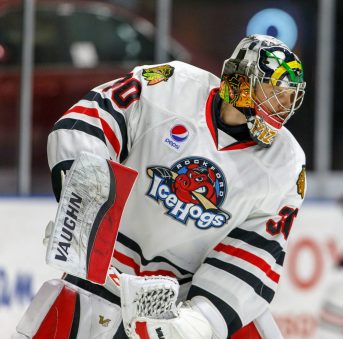
It was bittersweet to see last season when Liambas signed an NHL contract through the Chicago Blackhwaks. He earned an NHL contract but wasn’t just leaving the Admirals organization but playing head-to-head against them as a member of the Rockford IceHogs. He has his moments but, one season later, finds himself right back in familiar surroundings in Milwaukee. It hasn’t taken long to see what bringing Liambas back to the team does for the team. It doesn’t take much from watching him at team practices as to why he wears an “A” on the front of his jersey. He has the keen ability to know when to get his teammates to laugh and when to get them to listen. He can bring them together post-practice and come up with a silly activity such as who can hit the net on the fly from a slap shot taken at center ice. He can then skate on up to an individual player to communicate through details and specific questions. And, once the puck actually drops, he can make even the best of the best impressed for the compete level that he brings to the ice.
“He’s a warrior that guy. I’m impressed. It’s amazing. He’s got a big.. a big set of…” ~Pekka Rinne on 2/28/14
That is Liambas. One player in a group of now 22 players on the Admirals roster. Trevor Smith is one of those leaders. Harry Zolnierczyk and Adam Payerl are those type of leaders. Adam Pardy, someone who only recently acquired, is now one of those leaders. And what do they all have in common? They are good quality people as well as quality players. It is an aspect of the Admirals in recent years to bring in quality people as much as they are a player on the ice. And it makes plenty of sense at the AHL level when wanting to set an example for the professionalism required to reach the end goal of playing in the NHL.
(Photo Credit: Andre Ringuette // HHOF-IIHF Images)
It is then that this ideal of what it is to have a solid locker room with quality people as well as players also gets found by the Nashville Predators scouting process. This isn’t limited to players that the Predators draft, either. Frédérick Gaudreau, Jimmy Oligny, Trevor Murphy, and Matt White were all undrafted players that made their way into the Admirals roster. Those names were solid players and leaders who wore letters in their junior or collegiate playing careers before becoming professional hockey players. But, what of those who were drafted that exist on the Admirals roster right now? Alex Carrier was an alternate captain for three of his four-year junior career with Gatineau (QMJHL). Jonathan Diaby was an alternate captain for his final two seasons of a four-year junior career with Victoriaville (QMJHL). Jack Dougherty was an alternate captain in his one and only junior playing season for Portland (WHL). Félix Girard was a team captain for his final two seasons of a four-year junior career with Baie-Comeau (QMJHL). And, despite never captaining a league team, Vladislav Kamenev has served as team captain for his national team at the Under-18 and Under-20 levels.
So, why then should any of us be all that surprised that ten games into the 2016-17 season that the Admirals find themselves with the best record in the Central Division by claiming 15 points out of a possible 20 points and all while not yet truly playing their best hockey? It is because the team is comprised of a solid and grounded group of people. All that flash and all that offensive skill will come in time if the team continues to provide detail oriented hockey with an emphasis on not only minimizing mistakes but learning from the ones made.
There is still so much to come yet this season. There will be games when the Admirals manage to fall 6-1. There will be rough patches and stretches when players get recalled and swapped around. That’s AHL hockey. The importance is having precisely what the Admirals have which is high level leadership and character from a wide range of individuals in their locker room. It’s what takes those heavy defeats or stretches and turns them into something the likes of which the Admirals are on right now – a four-game winning streak. The Admirals a season ago had a special group that achieved pretty much everything but winning a Calder Cup as the team exited the BMO Harris Bradley Center. Much like the building they’ve returned to this year’s team has a character and a charm about it that might just see them take that extra step.
Welcome to the month of November. I know it is early but I feel it would be fun to already get some minor perspective into just how this year’s Milwaukee Admirals have been performing. We’re one month down into the season with seven games played. So, for fun, let’s gander at how the Admirals have looked under the Dean Evason Era in that opening month’s worth of games.
~Shots On Goal Per Game vs. Shots On Goal Against Per Game~
2012-13: 27.9 shots on goal per game, 24.6 shots on goal against per game
2013-14: 26.2 shots on goal per game, 28.3 shots on goal against per game
2014-15: 27.4 shots on goal per game, 28.4 shots on goal against per game
2015-16: 33.0 shots on goal per game, 30.9 shots on goal against per game
2016-17: 30.1 shots on goal per game, 29.1 shots on goal against per game
2012-13: 83 PIM (2 fighting majors, 11.6 PIM per game)
2013-14: 82 PIM (4 fighting majors, 13.7 PIM per game)
2014-15: 97 PIM (5 fighting majors, 13.9 PIM per game)
2015-16: 134 PIM (5 fighting majors, 19.1 PIM per game)
2016-17: 138 PIM (4 fighting majors, 19.7 per game)
There are a few areas that leap out to me and, hey, they’re as expected. This season’s penalty minute and power-play struggles are really bad. That said, as underwhelming as the offense has felt, look at how this year’s team is matching up against last year’s squad that ended up having a record of 48-23-3-2 (101 points, 0.664 points percentage) and won the Central Division. Things actually aren’t as bad as they seem. Much of the same personnel is back. Is this just a sign of learning from an early season lull before launching?
Happy Halloween, everyone. The Milwaukee Admirals seemed to provide a mix of tricks and treats along the way in the opening month of October. As much as that offensive fire power left everyone waiting on the edge of the seat I’m pretty sure the end response to the month finally had us all out of that seat. As sluggish or not all “there” as the Admirals may have felt in the first seven-games of the season they still end the month of October with a 4-2-0-1 (9 points, 0.643 points percentage) which is good for the best record in the Central Division.
The game last night in Rockford can certainly get a few names into the mix for the first entry for Admiral of the Month this season. He was a healthy scratch for the Admirals first three-games of the season but you can actually make a solid case that Matt White with his 6 points (4 goals, 2 assists) is the go-to guy for the forwards. He has only played four-games all season but matches Vladislav Kamenev‘s 6 points (3 goals, 3 assists) for the Admirals scoring lead at the moment.
There are other options, as well. I feel Matt Irwin did a terrific job all-round for the Admirals on the back end as part of the lead defensive line alongside Petter Granberg. Irwin played in the opening four-games of the season but has since been up with the Nashville Predators where he has logged a pair of games so far. Adam Payerl has been really good out of the gate and operates in all capacities the team can throw him into. And while the numbers aren’t there yet to show for it Pontus Åberg has been incredibly energetic and creative for the Admirals. His numbers will come in due time.
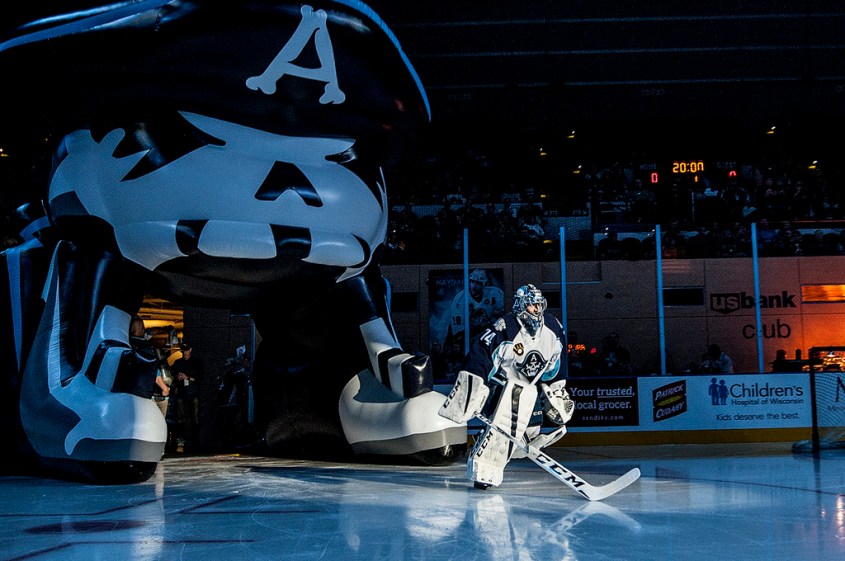
All that and it feels like there could only be one proper choice for the month of October: Juuse Saros. The Admirals 21-year old netminder from Finland has been terrific to start the season. The lone exception so far was his performance in the home opener when two of the three goals he allowed on the night dribbled past him. That said, he went 4-1-0-0 from five-starts with a 1.81 goals against average and 0.934 save percentage.
What’s most impressive to Saros’ work so far has been the effortlessness of his work in net. He looks smooth, confident, and -so- darn fast. The opening weekend on the road against the San Antonio Rampage very easily could have swayed a different way considering how tight the games were. But Saros stopped 51/53 shots on goal for a 0.962 save percentage in those two-games that ended by a 2-1 final score. That’s really better than terrific. That’s clutch.
It was by no true shock then that when all hell broke loose for the Nashville Predators due to a spell of food poisoning that he would not only go up on short notice, start on short notice against the current defending Stanley Cup champions the Pittsburgh Penguins, but do as well as he did in that game. It really wasn’t shocking at all. That’s who he is. He allowed a goal after a quick defensive breakdown allowed a two-on-naught breakaway. He wasn’t mentally put off by that taking place. The stage didn’t get to him. The moment did overwhelm him. He just carried right on to make 34 saves and only allow that one and only blunder by the team in front of him to get the better of him for his first career NHL win.
Nothing really does surprise me anymore when Saros does things right, straight forward, or even flashy. It’s more the “he didn’t notice that the puck was between his pads” moments such as the home opener when you have an eyebrow raise. That comes with the rarity of the moment, though. He’s been as good as last season, possibly even a touch better due to the experience last year provided, right from the opening puck drop on the 2016-17 season.
~Admiral of the Month Award~
October: Juuse Saros
Who do you feel was the top performer for the Milwaukee Admirals during the month of October? Was it Juuse Saros, Adam Payerl, Matt White, Vladislav Kamenev, Matt Irwin, or someone else?
Hype is a gift and a curse. There isn’t hype without a particular reason to get excited over a prospect. And, naturally, with the right amount of hype the ingredients can exist for that hype to never be met. Juuse Saros is a goaltending prospect that entered the North American pro hockey scene a year ago with a whirlwind of hype behind him and has been showing time and time again that the hype comes with great reason: he’s brilliant.
The long term planning that takes place in the organization can really come in waves when it comes to forwards or defenseman. As for goaltending you only have so many in play at a given time before you kick one out and look for a successor to join that prospect talent pool. Having a Pekka Rinne atop that totem pole is fantastic, because it is, but even he in his draft class wasn’t the first goaltender selected by the Predators. Of the eleven draft picks the Predators had in the 2004 NHL Draft the team selected Kyle Moir in the fifth round as their fourth selection while Rinne was drafted in the eighth round as the tenth selection. One of those two turned out to be a franchise building block. And the other was named Kyle.
With a goaltender in Rinne the Predators have had stability between the pipes for what is now the ninth season where he’s expected to be “the man” in net. That isn’t a luxury a lot of teams get to say. And when looking at the Predators draft history at the goaltending position ever since Rinne’s draft year – you kind of understand why.
Obviously the latter of the names are your current wee-nippers in the early stages of their developmental process but for much of the rest it is long done and dusted. And out of the names above who actually truly manifested into something the likes of a Rinne or to be his battery-mate in Nashville? The closest two would be Lindbäck and Mazanec. The rest just never really went to plan – or are hoping to be on the path to.
It’s this long and twisty path that gets us to the present and a present in which Rinne is a soon to be 34-year old. How many more seasons does he have in the tank where he is the reliable and dependable option as “the man” in net? It is that such question that makes Saros and his arrival all the more exciting.
(Photo Credit: Hämeen Sanomat)
In the off-season of 2015 it became clear that Saros was getting ready for his first pro season in North America. The question then was simple. Who is the odd-man out: Hellberg or Mazanec? That answer became Hellberg who the Predators traded to the New York Rangers and Saros had his spot opened up to play in the AHL as a 20-year old rookie. He entered having already played two full-seasons of pro hockey in his native Finland with HPK where he logged 91 games. As an 18-year old rookie in SM-Liiga for HPK he threw down a 1.76 goals against average and 0.923 save percentage in 44 games – as an 18-year old. That is where the hype train started and, with him and his hype effectively giving Hellberg the boot, the expectations of the 2015-16 season were incredibly high.
(Photo Credit: Scott Paulus)
When I met Saros that opening Training Camp in Milwaukee ahead of last season it became very clear that he was in fact a special sort of player and person. Similar to Colton Sissons when he arrived out of Kelowna you just didn’t get the feeling like Saros’ age was what it was for how he conducts himself. His professionalism off the ice translates to the ice. And his high level work ethic made the transition from Europe to North America look seamless. In his first season in North America as a member of the Milwaukee Admirals in the AHL he split the deck with Mazanec in terms of starts. Both goaltenders had 38 starts, each. The two pushed one another incredibly hard to get time in net and that friendly rivalry meant for sharp seasons for all parties.
When it comes to European to North American transitions, especially at the AHL level, I get to see a lot of kinks and mistakes made. It makes sense to see that though. The rink is smaller. The game is faster. And, especially in net, the placement of rebounds and teams shooting to setup for rebound opportunities isn’t so much what you see in the European style game. Everyone can go through the process differently but the adjustment period exists whether it be fast, slow, or never adjusting to it at all.
So, with that in mind, let’s look at the last three goalies that the Admirals have featured as European goaltenders making their North American debuts at the AHL level: Hellberg, Mazanec, and Saros.
Hellberg’s debut season was rather remarkable, especially the end to his 2012-13 AHL season, but the minutes played and volume of wins favor Saros as a guy who was leaned on and responded. And that’s coming from him when he was 20-years old – a year younger than Hellberg and Mazanec’s AHL rookie season.
(Photo Credit: Scott Paulus)
What impressed me more than anything you’d find simply by the numbers a season ago for Saros was his reliability. Never once did he look phased or overwhelmed by the North American pro style game. If the adaptation process existed for him it was a matter of a blink and it was over. He looked and played the part of, well, his counterpart last season -Mazanec- who had already logged three pro seasons with the Admirals to get to that point in his developmental process. Saros didn’t have a gaffe such as Hellberg’s rookie season letting in a shot that was aimed as a dump in for a line change that turned into a goal. Saros didn’t have episodes of deer in headlights that Mazanec would have in spurts in his first two pro seasons. Saros didn’t have any of that. He looked, played, and acted as if he had done it all before when in fact it was his first rodeo.
(Photo Credit: Sarah Fuqua)
When Saros received the call to get his NHL debut last season for the Predators he didn’t get the result he would have liked. The team lost 4-1 to the Buffalo Sabres while Saros stopped 20/23 with the Sabres cashing in twice on a power-play stemming from a major penalty. The result didn’t go his way but the experience was taken in. The rush of the NHL debut ended. And then came a certain food poisoning outbreak that allowed for Saros to get a second crack at it all over again this past Saturday. All he did was stop 34/35 shots on goal against the defending Stanley Cup champion Pittsburgh Penguins and, surprise-surprise, look comfortable while doing it en route to his first career NHL win.
Nothing actually surprises me anymore when it comes to Saros. When he’s tabbed as the goaltender for an Admirals game, even as early as mid-way through last season, there was a calmness in the air knowing he was the last line of defense on the night. He’s 21-years old right now and still very much absorbing a ton that the North American game has to offer. It’s never mattered that he’s less than six-feet tall because his game preparation, compete level, and lateral quickness more than account for any issue that size might have. The further he gets pushed up the ladder the faster the game is going to get. His ability to adapt quickly, as evidenced Saturday night in Nashville, shows just why the hype is what it is for him.
It’s not all that clear how the Predators play Saros in the 2017-18 season but the objective for this year is. He is the Admirals anchor this season. He will log a ton of games, minutes, high-pressure situations, and get a chance to be “the man” for a team looking to win a Calder Cup for the first time since 2004. The amount of experience that can be absorbed and learned from this season for Saros is going to be important to take in. Because it might just set him on the path that another Finnish netminder took right out of Milwaukee.
The current state of the Milwaukee Admirals roster heading into the 2016-17 season features a roster the strengths of which hasn’t been seen in a long time. There are numerous players sitting on the edge of being an NHL call-up. Some are veterans. Some are prospects right on the radar. And some are prospects that can shoot into that radar this season.
It’s shouldn’t be that surprising that players such as Petter Granberg and Austin Watson would be high on that list of potential quickfire call-ups. Both went through the waiver wire process and were assigned to the Admirals to start their season in the AHL. With the exception of a conditioning assignment that Granberg had last season both were in the NHL season for the whole of the 2015-16 season. Yet, of the two, one seems more capable of achieving an NHL return during the course of this season while the other one is named Watson.
I still find it curious how Watson’s 2015-16 season played out. Last season was the first part of a two-year contract that saw the first stint work as a two-way deal before turning into a standard NHL one-way contract. It seems the reverse of that contract is playing out right now: NHL the first half, AHL the second half. The only explanation I can cook up on last season is that head coach Peter Laviolette must have liked enough of what Watson could provide to either (a) play him (b) keep him as a rotational forward option. At some point he must have been close enough to being sent down, as evidenced by a fully prepped Admirals road jersey seen at the team’s Garage Sale this off-season, but it never came to be. He spent the whole of the season with the Nashville Predators and logged 57 games in the process.
Now that Watson has fallen down to the AHL there is a simple and concise question to ask: now what?
Watson already has 229 games of AHL experience to his name. He is one of only three Admirals in the team’s AHL history to score 20 goals or more in each of his first three seasons: 20 goals (2012-13), 22 goals (2013-14), and 26 goals (2014-15). He was also one of the most durable players the Admirals featured during those three seasons. The only reason he missed any AHL time during those three seasons were due to a 6-game spell in the NHL with the Predators during the 2012-13 season. Beyond that? He has a 100% record of showing up to work. Which, given his shot blocking prowess on the Admirals penalty kill at the time, is mightily impressive that he never was dinged up enough to facilitate an unhealthy scratch.
He’s a solid AHL level player. The numbers scream it. His versatility at the AHL level shows it: center, wing, penalty kill, power-play, etc. And yet here we are. Now what?
I feel the reason why we are where we are with the Predators first round draft pick from the 2010 NHL Draft has more to do with the prospect pool around Watson than Watson himself. He is a very strong and polished player. Watson isn’t the sort of player you would pick out and say he made boneheaded play after boneheaded play. The problem is, compared to all that are bottled up behind him, Watson is never going to be able to provide the high level speed and skill to go with his polished game. Frédérick Gaudreau is a perfect example of just the sort of player that is comparable to Watson and should be considered a better option as a call-up than Watson. Gaudreau has Watson’s versatility and range of use all while being a much faster skater with the skill to be more of a threat on offense. Then comes the freight train of names that could pretty much say the same: Calle Järnkrok, Viktor Arvidsson, Miikka Salomäki, Colton Sissons, Kevin Fiala, Pontus Åberg, and Vladislav Kamenev.
The only true player in the mix where you can have an argument over “Watson vs.” would be Cody Bass. Even that becomes a pretty cut and dry case. Bass is a chiseled veteran with great face-off skills and provides a far -far- more physical element to his game than Watson does. As big of a forward as Watson is, with the exception of one awesome hit to Ryan Getzlaf, he never really used his body as a battering ram to compensate for a lack of pace that others around him feature to shadow over him. Bass does lay the body down to bowl people over. Salomäki has the reputation as a bull in a china shop for his checking abilities. Watson? He’s just an alright smooth player that goes about his business. Which is fine. But it’s not a long term skill set to be an NHL level talent.
What Watson’s 2016-17 season is going to really need isn’t just what everyone knows he’s capable of at the AHL level but a display of what he hasn’t been capable of in the NHL level. He needs to start being a force to be reckoned with. He needs to start grinding people up to go along with his knack for scoring and penalty killing that he is already good at. Watson needs that extra dimension to his game or else I hazard to guess what sort of contracts would be on offer for him in the 2017-18 season. He already fell through the cracks of a waiver wire process. No other team in the NHL wanted him. That shouldn’t be met with anger or despair. It should be met with a wake-up call.
The talent level in hockey right now is shooting to the moon. Next off-season Watson will be 25-years old with a smattering of NHL performances. Watson could either become just who Bass was for the organization last season or Max Reinhart. One of those names are in the NHL. The other is in Germany. Watson’s response this season will go a long way to see whether or not he reclaims an NHL opportunity. And that goes for with the Predators organization and beyond.
Juuse Saros showed no signs of getting lost in translation as he made the leap from Europe to North America last season with the Milwaukee Admirals. (Photo Credit: Scott Paulus)
Today marks the first day of on-ice activities for the Nashville Predators Pre-Season Camp. And with that comes the counting down of days until the Milwaukee Admirals’ coaches and players migrate North for their own Pre-Season Camp. There is no official date set in stone just yet as to when the Admirals will take to the ice at the MSOE Kern Center and that comes from two key factors: the on-going World Cup of Hockey and on-going construction at the UW-Milwaukee Panther Arena. That primary factor is that of the World Cup of Hockey which affords coaches and players due for Milwaukee that extra bit of time in Nashville with the big camp and allows for the last rounds of construction to be completed before the Admirals move into their brand new home for the 2016-17 season and beyond.
~The Big Three Questions~
A variety of important storylines are being presented right now in Nashville: Will Kevin Fiala make that extra leap this year and start with the Predators on opening night? Is Marek Mazanec actually the lock for the back-up role to Pekka Rinne or is Juuse Saros capable of stepping in now? What final pieces and parts will stick in place and who falls to Milwaukee?
(Photo Credit: Sarah Fuqua)
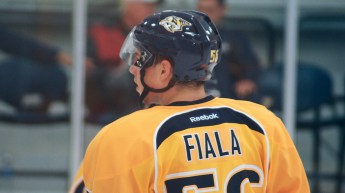
Tackling those one at a time means starting with the big one, Mr. Fiala. Around this time a season ago there was all the feeling in the world that Fiala was going to climb into a role out of Pre-Season Camp despite the immense competition surrounding him. That didn’t happen. And the impact of Fiala being cut from Predators camp was something that lingered into the start of his AHL season. By no means was last year any sort of a lost season for Fiala. Instead I’d say it was exactly the season that he needed to grow as a man and as a player. For all the adversity there is out on the ice the battles off the ice are far more trying and taxing. Fiala was essentially cut from a big team for the first time in his career after having called his shot the months prior by saying he would make the team. It wasn’t so much his ability to lead the Admirals in scoring last season that was impressive as much as it was him overcoming early season struggles and accepting his place and roles with maturity. There were some hiccups along the way, team and league suspensions, but they were all taken as part of the learning process and taken to heart. By season’s end the Fiala on the ice and in the locker room from that of the start of the season were two different people. Should he make the Predators? Last season will have proved to work exactly as hoped for by Predators management, coaching, and the guidance given by the like in Milwaukee. Should he start the season in the AHL? He will have had last season’s situation to fall back on and know that all he truly needs to do is keep working. Either way, Fiala should factor into the Predators this season. It’s really just a question of if it manifests immediately or not.
(Photo Credit: Scott Paulus)
Mazanec or Saros? That’s a question that came about a fair bit around Milwaukee last season but its now a Pre-Season storyline in Nashville. The assumption would be that Mazanec, who has both the time logged in the system and NHL experience to boot, is the front runner to back-up Rinne. I agree with this assumption for two reasons: (1) Mazanec has paid his dues and is coming off of his most consistent season since arriving in North America. (2) Saros is still incredibly young and should get the experience of a full-season at the AHL level of being heavily leaned upon as “the guy” in net. Rinne played 147 games in Milwaukee at the AHL level. Mazanec, 118 games. Saros, 38 games. There’s no telling whether or not the Predators eventually fast track Saros but the only way they can confidently or remotely go with that as an option is to give him a full-season as a first choice goaltender in the AHL. In Rinne’s first season with the Admirals he played in 51 games. In Rinne’s last season with the Admirals he played 65 games. Saros literally 50-50 split starts with Mazanec last season at 38 starts per goalie. That needs to be upped substantially and it will be a true test of Saros ability as well as endurance. Therefore it isn’t exactly time to pull the trigger on Saros. But, should he pass with flying colors as he did last season but on an even larger sampling size, it will give plenty of people something to think about next off-season.
(Photo Credit: Scott Paulus)
And to allow for a better note on Mazanec as the choice of back-up to Rinne I tell Nashville fans this: relax. It’s bizarre to think that for as good as Rinne is that there is this unease in the air regarding his ability heading into the season. Last year’s 2.48 goals against average wasn’t all that great but his ability to bounce back for the better has only really seen further regressions twice (2008-09 to 2009-10, 2011-12 to 2012-13). He is still going to be great in net. Mazanec, in the same light, is now being promoted into a role he’s been groomed for. His progressions in the AHL have been steady but last season was an eye-opener. Mazanec entered the 2015-16 season seeing his previous year’s battery-mate Magnus Hellberg get traded to make way for the young hyped up goaltending prospect Saros who would be pushing for playing time in net. Mazanec could have fallen flat on his face, Saros could have steam rolled him and started more games, but the two split starts. Mazanec had his best AHL season, in my book, in 2015-16 and only a stinker of a regular season finale in Rockford by the team in front of Mazanec cost him the statistical numbers to cement that as a 100% fact. Mazanec is ready. He’s always been ready as proven by his past work for the Predators. Now he just has the chance to match his AHL level work in the NHL.
The final question is more of a sitting and waiting game. The Pre-Season Camp roster provides plenty of insight as to who could be on the AHL and ECHL radar given the attention provided by Nashville from Development Camp through the recent Rookie Camp and Tournament.
Out of those names there are already a few to keep a firm eye out on. Robinson became a familiar name when he joined the Admirals at the end of the 2014-15 season out of Dartmouth and proceeded to start the 2015-16 season with a bang before a knee injury around Thanksgiving ended his season. He took to the ice for the Rookie Camp and Tournament and looked just as dynamic as he did at the start of last season. I feel comfortable in saying he is a Evason-style player in that he always works hard and “does the right things.” If he is fully fit he should at least be due for Milwaukee once Pre-Season Camp begins and is likely for the ECHL as a flex player the Admirals could utilize again this season.
The next name that I think we should be getting used to is Boudreau who was a participant at this year’s Rookie Development Camp and has been brought into the mix again for the full-range of Predators Pre-Season activities. That same tag can be given Sawchenko but, unlike the goaltender, Boudreau is done with his junior playing commitments and is set for his first year of pro hockey this season. Boudreau made his professional playing debut last season as a member of the San Jose Barracuda in the 2016 AHL Calder Cup Playoffs. He was a second round draft pick of the San Jose Sharks in the 2013 NHL Draft and I’m willing to bet that high draft selection came due to his shot. I’ve watched him in person and his shot is a deadly one. He hits his wide variety of shots with pop and a very quick release. If the Sharks let him go? It’s the Predators gain to secure this 21-year old who still has plenty of potential.
~The Back Up~
For the sake of things let’s keep running with the assumption: Mazanec in Nashville, Saros in Milwaukee. That’s great. It makes a lot of sense. But who backs up Saros is debatably the biggest question facing the Admirals heading into the 2016-17 season.
(Photo Credit: Todd Reicher)
Think about the onslaught of names that are behind Saros right now in the AHL/ECHL pipeline and the situation that awaits the Cincinnati Cyclones once everything falls into place: Jonas Gunnarsson, Mark Visentin, Brandon Whitney, Steve Racine, and Joel Rumpel. One of those first three names listed will compete for the back-up spot. The rest will end up in the trenches down in Cincinnati. The front runner to back-up Saros right now would likely be Gunnarsson but a 100% healthy Visentin could prove to be quite the competition heading into the season. Just because Saros made last year’s transition from Europe to North America look easy doesn’t mean that it is the same for everyone. If there is any true positions in the game of hockey that get exposed in that transition it is in net and on defense where the pace of the game can cause all kinds of havoc that wasn’t experienced in the Swedish or Finnish leagues. I’ve watched Gunnarsson up close this Summer and liked what I saw. He looked alright in the Rookie Tournament, as well. But when the temperature drops outside and the real games are played what kind of Gunnarsson is going to show up as an AHL goaltender? This is a goaltender that was basically tabbed over Janne Juvonen despite Gunnarsson having teatered between the top two flights of the Swedish Hockey League in his career while Juvonen has been the go-to for Pelicans in the top flight of Liiga the past two-seasons. It’s a risk. Visentin and his injury history, it’s a risk. Whitney, who struggled mightily last season in the ECHL, it’s a risk. If Saros will be “the guy” for Milwaukee he really is going to be earning that title if some of these depth selections don’t pan out.
~Don’t Forget About Me~
People know about Fiala. People know about Saros. Nashville was introduced to Pontus Åberg last season in the playoffs and there is a sense of anticipation for Vladislav Kamenev this season. Yet, someone I don’t often hear spoken of in these prospect conversations is a guy who hit the AHL running last season by the name of Max Görtz.
(Photo Credit: Christina Shapiro)
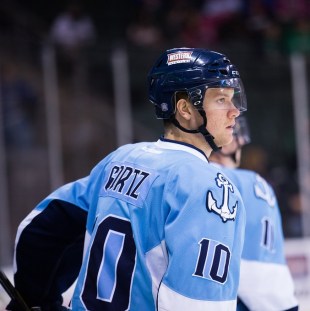
Görtz narrowly missed out to Fiala for the highest scorer on the Admirals roster last season. The Swede scored 47 points (18 goals, 29 assists) in 72 games. There are two stats I point to when comparing Görtz and Fiala last season, penalty minutes and plus/minus. Görtz had 18 penalty minutes to Fiala’s 78 penalty minutes, Görtz plus/minus came in at +14 while Fiala’s was -19. You can eye-roll the plus/minus as a stat all you want, call it a fluke stat, but that margin between the two is that of the second best forward and worst forward in that category on the team last season. In fact, Görtz was tied for second best in plus/minus on the entire team with defenseman Jimmy Oligny with both trailing leader Max Reinhart by a +2 margin. Görtz all-around level of play last season was reliable and, at times, explosive. In the month of December he scored 15 points (5 goals, 10 assists) in 13 games en route to being named the AHL Rookie of the Month. With one Swede with a power shot gone from the Admirals power-play, Viktor Arvidsson, who stepped in? It was Görtz – who hammered in a team best 11 power-play goals. Only seven players in the AHL scored as many or more power-play goals last season than Görtz. He also had 11 power-play assists last season which had him tied with Kamenev for fifth on the team.
His ability to score and his shot were known coming into last season. Would most have expected it to show off as well as it did in his debut season in North America? Not likely. But the element that ties everything together nicely is the on-ice maturity he displayed right away. Mistakes are minimal. Penalty issues don’t come up all that often and that comes from a big bodied player that can battle along the boards to get pucks. He isn’t careless. He showed a patient approach to his game last season and it paid off. Now that he should be a lot more comfortable knowing the North American game and the system of hockey the team looks to provide it is going to be a fascinating watch to see if Görtz can go from the guy that people just aren’t talking about to the one they would most like to see get called up in the middle of the season.
~Four More~
What excites me the most about the 2016-17 season for the Admirals isn’t as much the new venue they will be playing at but that pretty much all of last year’s team will be returning. You know, that team that went 48-23-3-2 (101 points, 0.664 points percentage) and won the Central Division? Sure there are some veteran names that left but some veteran names were added right back on. That’s the life of an AHL team. But the added entertainment value of the life of an AHL team is the new talent and prospects that join year-to-year. This season there will be four first-year pros that were drafted by the Predators that could make splashes straight away: Justin Kirkland, Anthony Richard, Jack Dougherty, and Alexandre Carrier.
(Photo Credit: Marissa Baecker // Shoot the Breeze)
If forward roles weren’t stacked enough for the Admirals in the 2016-17 season they will be seeing the inclusion of Kirkland and Richard. It’s worth noting that Richard made his pro debut in the playoffs with the Admirals last season and looked energetic despite playing with a lower-body injury. He’s healed up. And now he gets to really open up the throttle for his first full-season of pro hockey. As for Kirkland? He should be the one everyone is most excited to see take to the ice for the first time this season. When everyone was busy talking about Jimmy Vesey my mind shifted towards Kirkland. He’s younger, bigger, stronger, and more dynamic. The true selling point between the two though is that Kirkland sounds like just the type of player that an Evason is going to love to coach. He can play center. He can play out on the wing. Better than that? It doesn’t matter to him as long as he is out there doing what the coaches are telling him.
Defensively this year’s Admirals group will be a young one but I feel that’s been the conversation these last few seasons. Adding Matt Irwin should be a positive influence on the group but the hope is for guys such as Oligny and Trevor Murphy to really up what they were able to achieve a season ago as players such as Dougherty and Carrier enter the mix.
Dougherty has been in a storm these last few seasons where he can’t quite settle down and grow in the same place: USA Hockey National Team Development Program (2013-14), University of Wisconsin (2014-15), and Portland Winterhawks (2015-16). Hopefully by coming on-board with the Admirals he will finally have a stable platform from which to build from because, despite all the rapid changes in scenery, he has still done very well for himself. That showed late last season when he managed to play for 3 games with the Admirals. The pro debut is out of the way. His first pro point has already been achieved. He knows the team, its coaches, and its players. Perhaps this season is one where he can finally settle in and blossom.
Carrier is the one player on this list where I fear the numbers game could potentially rattle him down to the ECHL for his first full-season of pro hockey. That wouldn’t be a bad thing but my experience this Summer seeing his line-work with Murphy really makes me hope that they stick together for awhile. The two had instant chemistry and have games that are quite similar to one another. They aren’t the biggest defensemen on the ice but their skating and puckhandling skills make-up for the size. If the Predators defensive structure and the ideals of what it is to be a Predators defenseman is to be an active offensive presence by joining the rush while utilizing that same skating and attacking ability to defend? There might not be a better example coming down the pipeline than a paring between Murphy and Carrier. I just hope Milwaukee gets a chance to see it work this season.
~Closing~
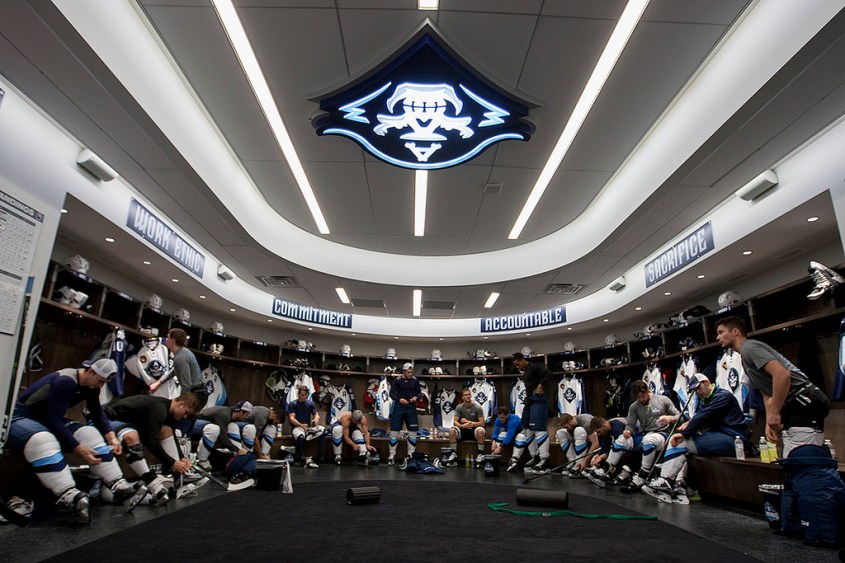
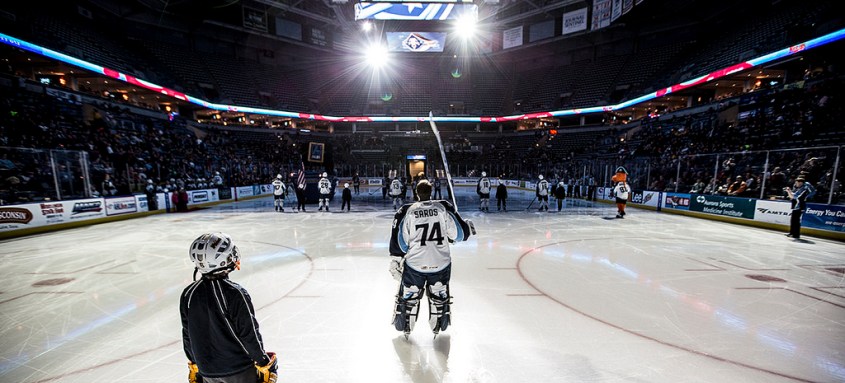
This season is going to be a roller coaster ride that far exceeds the on-ice product for the Milwaukee Admirals. It is a reintroduction of the UW-Milwaukee Panther Arena as the home to the franchise that it once housed when it was the MECCA. A changed environment is going to be a surreal feeling those first few games. I actually wonder just how many fans have actually never stepped foot inside of the UW-Milwaukee Panther Arena but are bracing for that first experience in close to a month’s time. Those who have experienced it but will be taking in all the renovations. Myself? I last attended an event in the building during the US Cellular Arena days for a Motocross event with my dad when I was a middle school kid. Seeing these changes to what I remember are simply impressive.
As last season was unique with new uniforms and the realization that the BMO Harris Bradley Center was no longer going to house Admirals hockey this too is going to have such a unique look and feel about it. While renovations will be on-going, as the old becomes new again, the constant that we can all rely on is that this year’s team should provide the same level of excitement that it did a season ago. The benefit of last season, despite the painful playoff exit, was the experience and the time provided to learn and grow. Those players are pretty much all coming back. The idea of unfinished business and multiple players looking to prove their NHL value right now should make the 2016-17 season a special one on the ice. And it will be paired at the hip with a special one off it as the Admirals well and truly have a place they can call their home.
He’s a pretty good one. And Juuse Saros will be, too. (Photo Credit: Scott Paulus)
Last season here at Admirals Roundtable the feature interview series Fifteen allowed fans to get to know their favorite players off the ice that little bit better and to participate by submitting requests for who they wanted to hear from first. Little did I expect that on a few occasions non-player personnel would be requested to have on. The goal during the season for me is to access the players in the short while that they’re around. And I’m happy to say that was accomplished last season. With the 2016-17 season creeping upon us I think now is the perfect time to launch Season 2 of Fifteen with some of those non-player requests that fans asked for.
When I turned up to the Milwaukee Admirals front office late last week I went with this intention in mind. Admirals Owner/CEO Harris Turer and President Jon Greenberg were both actually early requests in the feature last season but I felt obligated to get to the players first. Both Harris and Jon always make themselves available so this timing came well enough for us to do an extra interview on top of this one.
One of the things I often admire about the Admirals front office, for those that haven’t experienced it first hand, is that it is very much a family atmosphere. The whole group is really a nice reflection of its leaders from up top where hard work is done but done while loving the work that’s being accomplished. That same family atmosphere out of Harris and Jon can also be seen at any Admirals game you’ve attended. Some owners take the luxury box seat and avoid the crowds. The Admirals Owner/CEO and President are always seated with the fans and often wearing jerseys with their own names on them if you needed an added reason to stop by and say, “Hello.” It’s really been this way since the two joined forces in 2005. Perhaps after this interview even more moments of “Hello” will be done.
Cheers to both Harris Turer and Jon Greenberg for spending the time to conduct both sets of these interviews. Again, the behind the scenes activities leading into the Milwaukee Admirals 2016-17 season is by far busier than the hockey news cycle this summer may lure you to think. I appreciate the time afforded by both to take a break for a moment to chat.
While the off-season news-wise hasn’t been all that eventful in regards to the organization there has still been plenty taking place behind the scenes for the Milwaukee Admirals. The franchise is set to reopen a history of hockey at what was once the fabled MECCA – now known as the UW-Milwaukee Panther Arena. The Admirals started playing playing hockey in that building in the mid-70’s before making the leap to the Bradley Center in 1988. The ol’ MECCA opened in 1950 and has seen its share of renovations and name changes over the years. The latest round of renovations though as substantial and come by way of the reunion of the Admirals and their former stomping grounds.
So, what is all happening behind the scenes and how are things progressing? Will the renovations around the concourse, as well as the construction of the locker rooms for both pro and youth hockey teams, be completed on-time? Where are we all going to park? And what will it be like going head-to-head with competition from across the street from the Milwaukee Bucks this season and beyond?
To answer those questions and more I ventured in to chat with Admirals Owner/CEO Harris Turer and Admirals President Jon Greenberg. This is the first of a two-part interview series I was able to conduct with the head of the Admirals front office with a Fifteen feature set for Monday. Originally the plan was for Fifteen only -but- we all enjoy talking about the business and the future of the Milwaukee Admirals. That allowed for this sit down with the two to learn more about where things currently stand at the UW-Milwaukee Panther Arena and how things are progressing.
Cheers to both Harris Turer and Jon Greenberg for taking the time to discuss everything connected to what has been a busy off-season of preparation on a whole new level for the Milwaukee Admirals front office staff. Fifteen with both Turer and Greenberg will turn up on Monday morning. Hopefully the 2016-17 AHL schedule won’t be too far behind that.
A few days ago I was questioning whether or not the seventh choice defenseman for the Nashville Predators would be Petter Granberg or Stefan Elliott. Now it appears they will be fighting for the eighth choice option with the seventh now being Anthony Bitetto after yesterday’s free agent signing of veteran defenseman Matt Carle. (Photo Credit: Scott Paulus)
In the past two days the Nashville Predators made moves to finally boost that defensive group of their’s. Relax, that’s the sarcasm that can be afforded when the top four defenseman on your team are: Roman Josi, P.K. Subban, Mattias Ekholm, and Ryan Ellis. With Petter Granberg being brought into the fold for two-years I felt that the matter of seventh choice defenseman could come down to him or potentially Stefan Elliott. Now that the Predators signed veteran defenseman Matt Carle I’m left thinking Anthony Bitetto is the odd-man out in Nashville -and- whether or not both Granberg and Elliott could be Milwaukee bound with first-year pro’s such as Jack Dougherty or Alexandre Carrier getting shipped to the ECHL all thanks to NHL overflow.
At this point in time the Predators current defensive group seems to be setting up with high-powered and full-throttled machines taking up the top two defensive lines with a good veteran presence mixed in as the third pairing.
Josi-Subban
Ekholm-Ellis
Carle-Weber
For those living under a rock, my apologies for not getting to much into it on this website’s end, but that Weber there is not -that- Weber. That would be Yannick Weber as the whole reason for getting Mr. Subban was trading long-time captain Shea Weber to the Montréal Canadiens straight-up. The -other- Weber signed a one-year deal on the first day of free agency and, to be honest, it was fairly quiet since that actually took place. That changed once Granberg and Carle were given the thumbs up.
(Photo Credit: Scott Paulus)
The true loser and odd-man out in yesterday’s news was Bitetto who looked to be taking that left side role on the third defensive pairing with Weber for the 2016-17 season. When Granberg signed his two-year deal no one really bat an eyelid on the matter. Bitetto and Granberg were the surplus to requirements for the Predators last season and figured in here and there until Bitetto started to pull further ahead between the two. Bitetto was still in and Granberg was likely the best bet for seventh choice defenseman. That changed yesterday when a veteran defenseman in Carle, someone that operated with Predators head coach Peter Laviolette oversaw with the Philadelphia Flyers for three seasons (2009-12), signed as a free agent with Nashville. The move should mean that Carle bumps Bitetto down the pecking order where he was already last man on the “ice-time for defenseman” totem pole and into that cobweb collecting, NHL payday collecting, and suit wearing position of seventh choice defenseman. It’s simply the downside of being on the fringe to being part of -no arguments here- the best and deepest defensive group in the NHL entering this season.
(Photo Credit: Scott Paulus)
Most may have understandably burned that last Predators playoff game from memory but my lasting image from that game, aside from wondering what happened with -that- Weber, was seeing a cool, confident, and aggressive Bitetto storming the ice. He looked to have really settled in finally and let loose. That made his contract extension all the better. Under my microscope here in Milwaukee Bitetto showed constant year-to-year improvements in his game as a member of the Milwaukee Admirals be it improving his professionalism by accepting a trip to the ECHL (2012-13), getting in better shape (2013-14), improving offensively (2013-14), and blending his game all together to be a complete defenseman (2014-15). Last season was his first full go at the NHL and, hey, there were speed bumps with signs of promise. Sounds familiar to a Bitetto I’ve watched previously. Allow him to access a seasonal performance and await to see his progression because he tends to make the necessary adjustments. Sadly, that’s going to be a bit more complicated now given he will need to do it from the outside in.
Where Bitetto loses out doesn’t stop purely on his playing time for this year’s Predators, either. The trickle down effect that the Carle signing has actually becomes an overflow in the talent pool that makes that two-way portion in Granberg’s contract make all the more sense for the 2016-17 season.
(Photo Credit: Scott Paulus)
Last season the Predators felt fine and dandy with two surplus defenders waiting in the wings if needed. That eventually ended up becoming three with Granberg being snagged off waivers and then back to two once Victor Bartley was sent on and then cleared the waiver wire process to reach the Admirals. The Bitetto and Granberg “on the outside looking in” setup allowed for Bitetto to play 28 games while Granberg played 27 games. If needed the Predators can go right back to this well. Either that or they can now play with the concept of trusting Bitetto as a seventh man anchor in the event he is needed while allowing Granberg, on his two-way contract, to start the upcoming season in the AHL. This is where we reach an overflow problem.
My assumption for the Admirals defense for the 2016-17 season was for a very clear cut concept based on what head coach Dean Evason started to preach in regards to having three left-handed shooting defenseman paired with three right-handed shooting defenseman. For how the off-season looked up until Tuesday I felt confident that opening night at the UW-Milwaukee Panther Arena would look something along these lines (pun intended):
Oligny-Elliott
Irwin-Dougherty
Murphy-Carrier
Jimmy Oligny won’t have his line-y Corey Potter back from the end of last season but he should have someone just as capable in Elliott to play alongside as the top defensive pairing. While signed on as a two-way contracted talent it is most likely that Matt Irwin remains in Milwaukee for the bulk of the coming season and the eventual 29-year old should provide a great security blanket for the likes of a first-year pro such as Dougherty who did log game-time for the Admirals at the end of the 2015-16 season. Then comes a question of what to do with sophomore defenseman Trevor Murphy? Well, the recent Rookie Development Camp in Nashville conducted by Evason and the Admirals coaching staff seemed to indicate an answer to that question considering Murphy and incoming first-year pro Carrier were paired the entire camp and looked great together.
And this is where the curveball of overflow from Nashville changes things…
Now that it appears that the Predators defense has gone to plaid (cheeky joke inside of a joke) the potential overflow of talent topside can alter things quite drastically for the Admirals and for the incoming prospects set for their first full-season of professional hockey. Let’s assume that both Granberg and Elliott end up in Milwaukee and that the Evanson philosophy of pairing of left-handed and right-handed shots on defense remains. The Admirals likely slot Granberg with Oligny as a shutdown defensive line, Elliott with Irwin to have a balanced yet attack minded line, and then are left to decide between Dougherty or Carrier for Murphy’s linemate all while Teddy Doherty and Jonathan Diaby familiarize themselves with Skyline Chili in Cincinnati. Given Carrier’s form at Rookie Development Camp alongside Murphy I have a hard time seeing that dynamic get split up which would make Dougherty the man on the fringe.
If this all sounds dodgy: relax. This is just a potential scenario and one that may not even need to happen if the Predators hold true to having Bitetto and Granberg watching from the sidelines until they are needed like last season. After all, if the Predators want Bitetto and Granberg to be stationary and not playing but just be there in the off chance a rotation is needed? They showed they can be up to the task a season ago and can give it a fair go once again this season. There is just one thing that creeps into my head and it is this. The Predators paying NHL level money to Granberg to be a stationary eight choice defenseman while the option exists to pay him less while playing him in the AHL doesn’t quite fit their typical modus operandi… although Austin Watson was a rare exception to that last season.
(Photo Credit: Scott Paulus)
Should Bitetto and Granberg end up falling into their roles held previously? It’s good. Should the Predators decide to go with Bitetto as that surefire fallback plan if someone gets injured and send Granberg down to Milwaukee to remain active? It’s good. At day’s end the beauty out of all of this defenseman madness is that the Predators have so much depth that it is almost problematic to try and figure out the best path for all parties to get set on the right course while maximizing team performance and career development for the prospects. Certainly Taylor Aronson and Garrett Noonan might have different opinions about how the thickening of glass ceilings at both the NHL and AHL level can hinder career progress. I’m hopeful that for Dougherty and Carrier’s sake that they don’t eventually find themselves this coming season, as first year pro’s, in situations that they shouldn’t be playing in with it then coming back as a year lost or not fully utilized.
The question of “whether the Predators will need an optional eighth defenseman in Granberg” will be one of those storylines to keep an eye out for once the pre-season starts up in late-September. It can go really two ways with possible repercussions that would not only impact the look of the defense in Milwaukee but also Cincinnati. Is there such a thing as having too much depth? Because I feel the Predators might test that boundary in 2016-17.
If you were in Nashville Predators General Manager David Poile’s shoes: would you keep Petter Granberg alongside Anthony Bitetto as defensemen in reserve or would you have Granberg start his season with the Milwaukee Admirals and have seven defensemen stationed in Nashville?
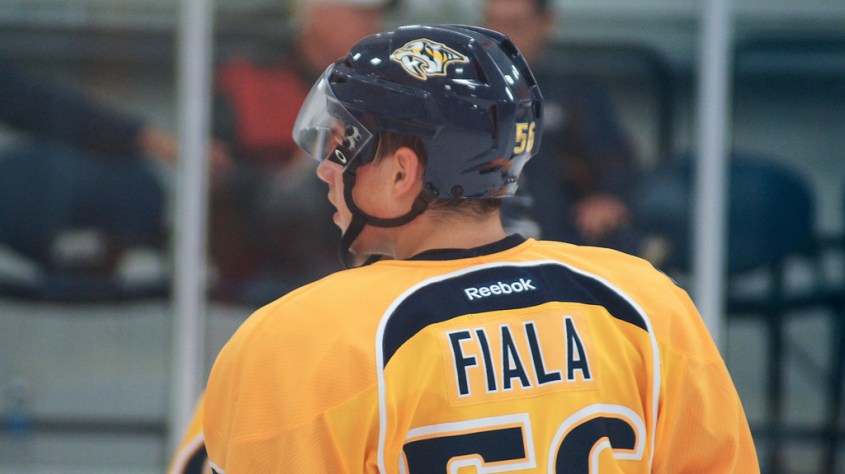
Rather than go the Ramblings route today I want to hit a topic that came up numerous times during my Nashville trip: Kevin Fiala.
As I’ve learned in my recent time covering the Milwaukee Admirals sometimes just saying that name is all you have to say. The reactions and range of opinions about Fiala shoot wildly across the board. People are high on him and think he’ll do real well when he gets unleashed into the Nashville Predators forward group. Other people don’t think he has enough going for him to be an NHL talent and already have looked past him for other shiny objects that Milwaukee is polishing to make even shinier.
During my recent trip to Nashville fans and fellow media colleagues asked me about Fiala a great deal. Questions such as… Will Fiala make the Nashville Predators opening night roster? Would Fiala playing more in the AHL this season than the NHL be considered a failure? Is his immaturity still cause for concern? …all came up. Allow me to get your Monday off right by tackling the question to end all questions in my small little working bubble: Fiala?
~The Waiting Game~
For those that don’t follow along with the Birthday dates for players it is worth doing this topic this week. After all, these are the last few days where we can consider Fiala as a teenager. He will be turning 20-years old on Friday and that age is a rather important one for quite a few points I’ll be making along the way.
(Photo Credit: Marissa Baecker // Shoot the Breeze)
This season with the Milwaukee Admirals there will be a drafted by Nashville rookie class that features three 20-year olds: Alexandre Carrier, Justin Kirkland, and Anthony Richard. All three of these players just completed lengthy junior careers. Carrier played 242 games with Gatineau Olympiques (QMJHL), Kirkland played 199 games with the Kelowna Rockets (WHL), and Richard played 232 games with Val-d’Or Foreurs (QMJHL). For the sake of added comparison the Admirals will also feature a rookie in the form of the undrafted 22-year old defenseman Teddy Doherty who played 144 games with Boston College (NCAA).
Fiala, as stated, will be entering the 2016-17 season as a 20-year old. Unlike the names mentioned above this will be his second full-season of professional hockey in North America and that comes after a 2014-15 season where he effectively played half a season with the Admirals. Prior to that he managed to play 37 games of professional level hockey at the top flight in Sweden with HV71. Fiala’s junior playing career ended when he was 17-years old. That junior playing career is dispersed from Swiss (Uzwil, Rheintal, ZSC, and GCK Lions) and Swedish (Malmö Redhawks and HV71) junior programs as well as the junior national team.
(Photo Credit: Scott Paulus)
Allow me to now pull this all together now. Fiala’s first true stationary proving ground with a consistent coaching staff to allow him to make mistakes, learn, and grow hasn’t exactly come until his leap directly to North America where he has now been since mid-January 2015. While Carrier, Doherty, Kirkland, and Richard have had similar surroundings and relatively the same teams as they progressed towards their professional playing careers… Fiala has been jumping ship upon ship upon country after country and yet another team change. Were he in the North American setting from the word “GO” this likely would be debut season of pro hockey. What often gets overlooked, beyond his age, is actually the route he’s taken to get exactly where he is and how unstable that process is by comparison to your run of the mill CHL drafted player.
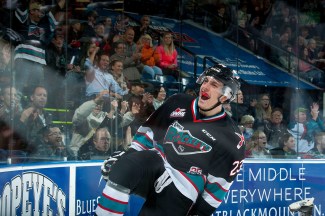
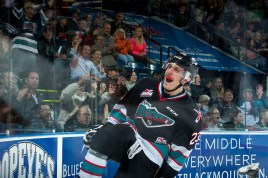
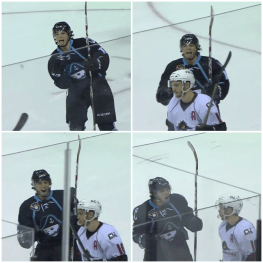
Kevin Fiala celebrates his game-winning goal in overtime on the road against the Lake Erie Monsters on 4/1/15 by screaming at Andrew Agozzino.
Moments that come to mind with Fiala range anywhere between his goal against the Texas Stars where he deked Jamie Oleksiak out of his skates before patiently out-waiting Jack Campbell for a deadly solo goal – and then him flipping off the Lake Erie Monsters bench, getting a game misconduct, and a subsequent two-game suspension from the AHL. So you get anywhere from talent to immaturity. It’s not even as if it was his first run in against Lake Erie, either. In his short AHL career he went after the Monsters under their AHL affiliation with the Colorado Avalanche (2014-15) and the Columbus Blue Jackets (2015-16). During his entry to the North American scene he felt the need to celebrate a game-winning overtime goal, on the road in Cleveland, by screaming into Monsters’ alternate captain Andrew Agozzino‘s face. Then team captain of the Admirals, Joe Piskula, needed to step in and wedge him aside. It was a microcosm of just what this young Fiala was all about. His competitive spirit is his often his best and worst attribute. It gets him on the scoresheet. It gets him in the penalty box. In the grand scheme of things – these instances don’t happen every single game but they do happen here and there. Learning to tone down the negativity of Fiala’s aggressiveness without detracting from what makes him -him- is, has, and likely will be a coaching point for the years ahead. The key here for everyone is this: patience. I’ve often cited a need for patience in regards to Fiala both for the fans and for Fiala himself. Amusingly it is for the exact same reason, too. You can’t be caught wanting so much so soon.
(Photo Credit: Christina Shapiro)
If opening night hits and Fiala isn’t part of the Nashville Predators roster it should not be looked at in any way shape or form as a failure. Fiala playing 2.5 years of AHL level hockey by age 20 isn’t a failure… it’s ahead of the curve. What makes it all the more better is connecting him towards the style that Nashville want him to play, at an AHL pace, to make that eventual arrival something a bit more polished that if he was fed to the lion’s den that is the NHL. Only a few true elite level talents excel or impress at ages 20 or younger at the NHL level. To expect Fiala, and his non-traditional path to reach the NHL in the first place, to be one of these talents isn’t exactly a fair viewpoint to hold – eleventh overall draft selection or not.
The more I value or look into what a Fiala in the NHL could be early on in his playing career the more I start to think of a Conor Sheary of the Pittsburgh Penguins as an example. They are both undersized wingers with great skating ability and tremendous creativity when on the offensive side of the puck. Sheary spent a full four-years at UMass-Amherst before a season and a half of significant AHL playing time put him towards a path to a Stanley Cup at the age of 23-years old. He’s four years older than Fiala with a knowledge of the North American game and his organization’s style rooted into him. Good things don’t happen in a flash because of draft selection placement they happen with adherence to the developmental process. Which is precisely why last season was just what Fiala needed.
(Photo Credit: Stephanie Moebius)
The 2015-16 season gave Fiala just about every single obstacle that you would want a 19-year old that’s adjusting to becoming a professional hockey player that you could want. He built himself up to make the Predators out of pre-season camp. He arrived at pre-season camp and was swiftly cut with a massive talent pool making sending him to Milwaukee seem like an easy option. People might not remember this but Fiala wasn’t alone in missing out on that Predators opening night roster last season. There was a bloke named Miikka Salomäki that started his 2015-16 season in Milwaukee before working himself back into the Nashville spotlight. Things worked out well for him after that but not so much for Fiala who really was experiencing being cut from advancing to a team for the first time in his playing career. This defeated feeling trickled to the ice… the goals, the scoring touch, and explosiveness to his game disappeared into the battle going on inside his teenage mind. The suspension seemed to act as the firm slap he needed to wake up – and he did. Fiala would go on from not having scored a goal until the Admirals sixteenth game of the season to leading the team in overall scoring by season’s end with 50 points (18 goals, 32 assists).
Along the way there were mistakes, sure. His plus/minus of -19 stands out against his offensive output but his defensive ability is slowly improving. His intensity to compete can often overwhelm his better judgement and it can lead to unnecessary trips to the penalty box. These are poor characteristics, yes, but things you’re likely to hear from with a player that has been dropped into deep water. Placing a player at an age of a junior level talent into a professional vortex and you have the ultimate stress test to see just what sort of product you selected with that first round draft pick in 2014. And you know what? He, much like the Russian youngster drafted in the round after him by the Predators, both survived that test last season.
(Photo Credit: Scott Paulus)
What fans should be anticipating for the 2016-17 season out of Fiala is a much looser, relaxed, and confident person on and off the ice. There were so many question marks and unknowns facing him when he arrived in mid-January 2015. The North American game was far different than he anticipated but now has a solid grip to just what is needed from a winger roaming North-South rather than coasting along the wider rinks that Europe feature. Living conditions and the knowledge of where to be comfortable and enjoy himself in Nashville or Milwaukee are taken care of. For some, this will be their third season playing alongside Fiala at the AHL level. Questions of who he’s playing alongside and how he can play with those players are answered.
This coming season for Fiala is going to be one in which he gets to be himself in North America, relax, and simply go to work – for really the first time since he arrived. Whether he’s competing at the NHL or AHL level that mentality and statement doesn’t change. The questions have been answered and replaced by new challenges that the previous year presented. The surrounding field competition now takes a backseat to competing against himself.
What the Nashville Predators organization has done is set Fiala up for a season where he is now settled into a comfort zone with his surroundings and can firmly compete against what he accomplished in 2015-16. What Fiala accomplished was being the top scorer on an Admirals team that ended the regular season off with a record of 48-23-3-2 (101 points) to clinch the franchise’s first divisional title since 2010-11. It is simply an exciting thought to me that the real message here could end up being, “top that.” If there were any challenge to set in front of Fiala before properly unleashing him at the NHL stage – it’s that.


 Admirals Roundtable